China’s Revised Regulation on Ensuring Payments to SMEs – Key Obligations and Practical Implications
China’s revised Regulation on Ensuring Payments to SMEs (hereinafter the “Regulation”), effective June 1, 2025, introduces binding payment deadlines, bans back-to-back payment clauses, and establishes real enforcement consequences for non-compliance.
1. Regulatory Background
The revised Regulation forms part of a broader legislative push to protect SMEs in China. In April 2025, the Standing Committee of the National People’s Congress adopted the Private Sector Promotion Law of the People’s Republic of China. The law aims to ensure fair market participation, competitive neutrality, and the protection of private enterprises’ rights and interests. Against this backdrop, the revised Regulation operationalizes key protections within this framework, targeting the persistent problem of payment defaults by government agencies, public institutions, and large enterprises against their SME suppliers and contractors.
2. Scope and Key Definitions
The Regulation applies whenever a government agency, public institution, or large enterprise purchases goods, projects, or services from an SME. The enterprise scale classification is determined at the time of contract conclusion—not at the time of any dispute (Article 3).
3. Key Provisions: What SMEs and Their Business Partners Need to Know
The following are the key provisions relevant to SMEs and their counterparties:
- Binding payment deadlines — the “60-day red line” (Article 9): Government agencies and public institutions must pay SMEs within 30 days of delivery as a default, extendable to a maximum of 60 days if contractually stipulated. For large enterprises, payment shall be made within 60 days of delivery, unless otherwise agreed in the contract. Any such agreement must be reasonable based on industry practices and trade customs.
- Prohibition of back-to-back payment clauses (Article 9): Large enterprises may not make payment to SMEs conditional on receiving payment from a third party (e.g., an upstream client), nor may they pay SMEs in proportion to or on the schedule of third-party payments. This directly prohibits a practice common in construction and supply chain arrangements, where SME subcontractors effectively bore the financial risk of upstream payment delays. This aligns with the earlier Supreme People’s Court’s Reply on the validity of back-to-back payment clauses (Fa Shi [2024] No. 11), which confirms that such clauses between large enterprises and SMEs are invalid.
- Overdue interest at a significant statutory rate (Article 17): Where a payer delays payment, overdue interest automatically accrues. If the parties have agreed on an interest rate, it must not be lower than the one-year Loan Prime Rate (LPR) applicable at the time of contract conclusion. Where no rate has been agreed, the statutory default rate applies automatically at 0.05% per day.
- Other important clauses include prohibition on forced non-cash payment methods (Article 11), partial payment obligation for undisputed amounts (Article 15), dedicated complaint channels and national platform (Articles 24–25).
4. Practical Responses for Businesses
In particular, companies should consider the following steps:
- Contract review: SMEs should review their existing contracts to assess whether they contain problematic clauses or payment terms against the Regulation, particularly back-to-back payment clauses, which will generally be treated as invalid by the People’s Courts in practice.
- New contract: For future contracts, companies should ensure that: (i) the SME status is explicitly stated in the contract; (ii) payment terms comply with the statutory deadlines; and (iii) partial payment obligations for undisputed amounts are addressed, along with other key considerations.
- Debt recovery tools: SMEs facing payment defaults may utilize a range of tools in sequence: lawyers’ letters, administrative complaints via the MIIT platform, court payment orders, property preservation applications, and formal litigation.
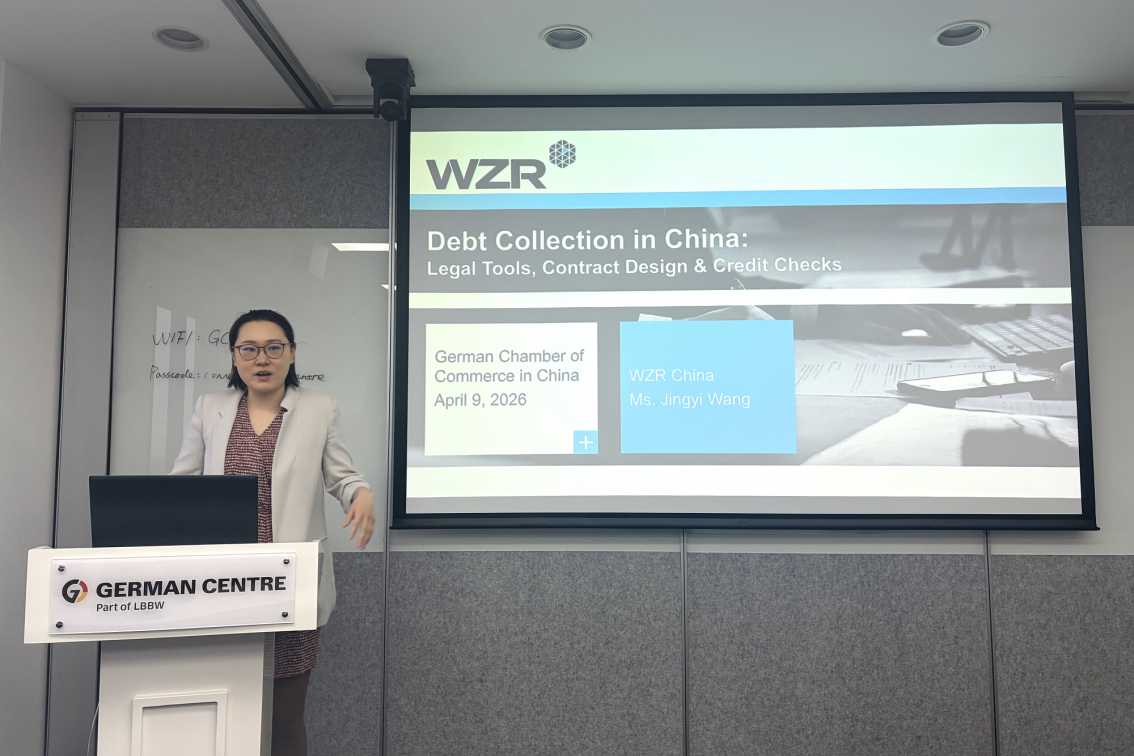
5. Upcoming Event: Debt Collection in China – Legal Tools, Smart Contract Design & Credit Checks
The German Chamber of Commerce in China and WZR China are co-hosting a dedicated session on debt collection and the SME payment protection framework. The event will take place on April 9, 2026, at German Centre Beijing and online. The session will be led by Ms. Wang Jingyi, Senior Associate at WZR China, drawing on her expertise in Chinese commercial law and international legal practice. Participants will learn about the following topics:
- What China’s new payment protection regulations for SMEs (effective June 1, 2025) mean for your business
- What key legal tools are available, including fast-track court procedures (“payment orders”) and property preservation measures, such as bank account freezes
- How to design payment terms, acceptance clauses and dispute resolution provisions
- How to run a quick check of China’s credit system to prevent issues
Sign up for the event under the link here.
Beijing, March 30th, 2026